Feeding Families, Meating Needs

The North Dakota Farm Bureau Young Farmers and Ranchers have come up with a program called “Feeding Families, Meating Needs.” In essence, they are arranging for donations of livestock or wildlife (or even money to cover the processing costs!), to be processed and distributed through the Great Plains Food Bank and Community Action’s Sportmen Against Hunger. What a GREAT program!

With the deer issues that we had this spring, we are looking at changing some of our management plans. We realize we need to handle our hay differently, we need to be more proactive and we need to be creative with our solutions. And so we shall.

Step one, I’m going to promote this program fully. How many people apply for a deer license and intend only to shoot a trophy deer, not concerned about the meat, because they don’t want to go through the hassle? How many pounds of venison is wasted every year? How many families could that feed? Let’s change that!

Here’s the scoop (and pay attention, because this is important stuff!):

Livestock – If you want to donate livestock, you need to contact Ann Pollert at Community Action, Sportsmen Against Hunger, to make arrangements. Processing will be done by approved facilities, and (if donated locally) meat will be distributed back to the region it came from. To contact Ann, call (701) 232-2452 or email annp@sendcaa.org .

Wildlife – You will need to contact the nearest approved processor on the Sportsmen Against Hunger list to verify that there are funds or vouchers available to cover the processing.

Money – This whole idea won’t go far without monetary donations to cover the cost of processing. Just to give you an idea, the processing charge for deer is estimated at somewhere between $50-55, beef is generally estimated at $40 per head plus 45 cents per pound on hanging weight, and then an additional 20 cents to grind. It all adds up quickly, and monetary donations will ensure the food banks receive these meat donations.

This food drive started in April, and will run through January 13, 2012. I am urging you to consider contributing, either through your successful hunting endeavors, an animal donation, or money to cover the costs of processing.

I’m going to bringing this up from time to time, especially as the deadline nears for deer license applications in North Dakota. Instead of applying for buck only, why not apply for buck first choice, doe second? Then, if you don’t get your coveted buck tag, you can still shoot a doe, prove your hunting prowess, get some exercise and target practice in, and donate the meat to a good cause?!? Win-win all the way around! (If you’re wondering about my hunting preferences, I normally apply for a gratis tag, which allows me to shoot either buck or doe, as long as it is on our land. In the last four years, I have shot one spike buck and three does…which made some very tasty sausage!)

If you need more information, shoot me a message, or contact Katie Heger (who’s heading up the program for the NDFB Young Farmers and Ranchers). You can get a hold of Katie at skheger6@gmail.com.

And stay tuned for some other ideas that we’ve come up with. We’re not going to go down in this battle with the wildlife without a fight! 🙂

Reflecting (Ag Book of the Day 10)

I’ve been reading more and more situations lately, where churches and others are making broad statements regarding farming, and the decisions that farmers should make.

I have a real hard time with that. I do not know of one farmer that would ever make a decision, based solely on financial gain, without thinking to the future or what will happen to their land if they abuse or misuse it. Yet, those are the implications that are made everyday by some that are not actually physically involved in production agriculture. Now, I’m not so naive as to think that those types of farmers/ranchers don’t exist, but we can’t cast down all of agriculture for them, can we?

Well, I don’t want to delve too deeply into it today, because it’s Friday, and it’s snowing, and I’m already in a bad mood. But I want to bring your attention to a blog I wrote about it a little while back…and I still stand behind it today. What if these tools have been given to us to use? What if technology isn’t an “accident” at all? Hmmm…

Anyway…on to Ag Book of the Day 10:

Today, I went with an old stand-by…not because I don’t have any others to choose from, but because I have it on my Kindle. How’s that for combining traditional ag-themed children’s books and modern technology??? Without further ado, welcome to

“Old McDonald Had a Farm” and it’s now available wirelessly! 🙂
not only does it have great illustrations (if you have the original version, the illustrations are definitely funnier, and not so politically correct!), but it also teaches young children about the sounds of the farm, and how busy it can be! And who can forget one of the greatest nursery rhymes of all time???
I just had to throw this one in the mix, since it is on my Kindle. Next week I’ll be back to more obscure and lesser-known books, but for now…ENJOY!

Looking to the future

Maybe I should actually title this post, “Looking FOR the future.” What do I mean? Well, once again, I was reading in a farm publication. (I think I need to quit doing that.) It was a very, very, very small brief. It was buried back in the regional news section on page 36 of AgWeek. And it stated that North Dakota is down 100 farms last year from the year before. (Statistics from the USDA’s Agricultural Statistics Service.)

Now, 100 farms doesn’t seem like a whole lot, but since agriculture IS North Dakota’s No. 1 industry, it should mean something to someone…and it should mean a lot more than a three-sentence blip in the back of a publication.

Again, I get that statistics get skewed in the whole picture. Some of the farms could have been non-existent for years, but were missed in the whole red-tape, paper-shuffle mess that we call government. But 100 farms is 100 farms. (To be fair, percentage-wise, that’s less than 1/2 of 1%.)

If you aren’t aware of the problem facing our world, we are gaining more and more people, and losing more and more farms and farmers. Any good statistician will tell you that those statistics don’t factor well for the future.

Perhaps the story of farm numbers dwindling should rank a little higher than page 36.

Only if you like to eat.

We have a ways to go

Well, once again my blog stats have amazed me. Today one of the search terms that directed someone to my blog was, “Where does ground beef come from?”

Really?

Well, this is where they were led, but I’m hoping they followed a long a bit and maybe learned a thing or two about raising beef. Although, I’m OK with them knowing where I stand on Taco Bell as well! 😉

To me, this just goes to prove that we have a long ways to go yet, before we can consider our jobs successful. Yes, social media is reaching the consumer, and yes, we are finally opening up the communication between the plate and the pasture, but we can improve.

And I can’t wait!

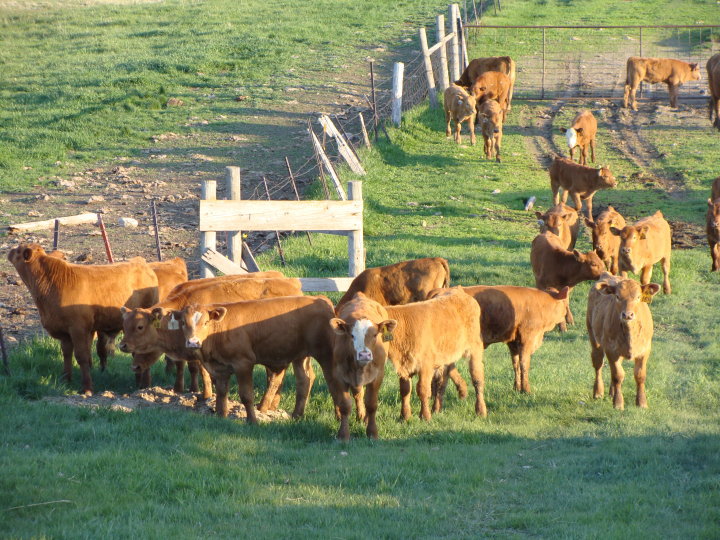
Oh, and to answer the question…this is where ground beef comes from:

The source of some of the world's best ground beef!

Blame game

I’ve been trying to catch up on some reading, which isn’t an easy task with little ones suffering from cabin fever. But an article that ran on the front page of last week’s AgWeek really got me to thinking.

You see, I’ve been repeatedly told on numerous websites, blogs, article comments, etc., that part of the blame for our country becoming increasingly obese is the amount of meat that is consumed…namely, beef.

Yet, according to the cover article (and facts, stats from the USDA), beef consumption in the U.S. is down by almost 20 pounds per person since 1985. That’s right, our country may be becoming more obese, but the amount of beef consumed can’t possibly be the cause.

This is how our beef gets from pasture to plate.

Now, don’t get me wrong, I’m not shocked by this information. I never bought into the argument that consuming beef is the issue with an ever-growing America. But it was interesting to actually see the numbers, right there, in black and white.

So, the next time someone tries to tell me that my family’s herd is part of the problem, not a solution, I’ll just kindly remind them of all the great-tasting, quickly-prepared cuts of lean meats available, and merrily go about my way.

You just can’t argue with ignorance.

Where’s the beef?

So, if you’ve heard the news lately, Taco Bell is being sued because someone was reading labels and decided that having less than 35% beef in your “beef taco” meant that a certain company wasn’t being very truthful in their advertising.
 
In response to the lawsuit, Taco Bell ran an ad across the country. It was a very bold ad, and as far as I’m concerned the ad made sure that I will never, ever again step foot into a Taco Bell…unless it’s to use the bathroom.
 
The ad started with the bold headline, “Thank You for suing us.” It then went on to explain why they use additives in their taco product and what is used in their “special recipe.” So why would that bug me? Well, the second paragraph starts off with, “Plain ground beef tastes boring.” Excuse me?
 
Perhaps they should buy higher-quality meat if they think it tastes boring…or maybe they should take a cooking class or two. Now, granted, not a lot of people would eat browned ground beef without some spices, mainly salt, pepper, onions, etc. And when making tacos, I would think that using taco seasoning would make sense to most.
 
Here’s my beef: I make tacos regularly for my boys. They LOVE them. I use ground beef and taco seasoning. I use a little water. It tastes GREAT, and in the process I have never used oats, or any other additive that would add a large amount of substance to my meat. And to claim that you have to, in order for tacos to taste good…I have problems with that.
 
The ad goes on to say: “The only reason we add anything to our beef is to give our meat flavor and quality. Otherwise we’d end up with nothing more than the bland flavor of ground beef, and that doesn’t make for great-tasting tacos.”
 
What???
 
Are you kidding me? Seriously? OK, I get that in order to make taco filling in large quantities, they probably add in a little extra here and there to help it stretch. I get that, I do. But don’t blame the beef. Be honest and tell your public that higher-quality beef costs more. That you’re adding other things so that your costs stay lower. Tell them the truth, not some spin.
 
I’d offer to show Taco Bell how to make a mean taco…without using anything but taco seasoning, some water and some really great-tasting ground beef. But I don’t think they’re very interested in actually improving their recipe.
 
Well, I didn’t stop at Taco Bell very often, but I will never stop there again. And my suggestion to other businesses in the food service industry…if you find yourself in a bind, don’t blame the ingredients. It makes you look like a fool. And whatever you do…
 
don’t blame the beef.

New perspective

We are entering a new ballgame here at the Wagner Farm. One I never expected to have to face, but can’t wait to see the results!

Our youngest son seems to have a condition that doesn’t allow him to breakdown proteins. The solution to this problem, at this time, is to limit his protein intake. Quite an interesting situation for a cattle family, to say the least. But, in the true sense of making lemonade out of lemons, I look forward to the road we’re going down. I can’t wait to see what I can learn!

Don’t get me wrong, my family will not become vegans, and I have no intention of changing our way of life, but everything will be done from a whole new perspective.

Now, I have always been one to understand that there are people in this world who make choices based on true science, medical advice and thorough research. I respect and admire those people and understand completely why they make the choices that they make.

On the other hand, there is an even larger group of people that prey on fear, sling mud and use emotion and distorted information to support their cause, and feel free to spread their misinformation around the cyberworld. Those are the people that I hope to refute.

We raise cattle…and we do a good job, if I do say so myself. We also raise corn, soybeans, wheat and alfalfa/grass hay. (And for the moment, we appear to be raising a pretty darn good crop of deer…much to our dismay.) Having a child that cannot consume these products, or at least only in extremely limited quantities, changes my perspective quite a bit…and that’s a good thing.

I find no fault with someone who makes a decision to elminate a product that I raise out of their diet for the benefit and well-being of their health, or in this case, a child’s health. When that decision is made based on the argument that I’m not caring enough for my animals…that’s where we part ways.

Care to join me on this new adventure? It’s gonna be a wild ride!

Lessons from home

I was watching EJ today at lunch, and it dawned on me that he has a lot in common with the people that I’m trying to reach and educate about animal agriculture. Bet you’re wondering what in the world am I talking about, eh?

Well, it went something like this:

Me: “EJ, would you like a grilled cheese for lunch?”

EJ: “No mom, me no like grilled cheese.”

M: “Well, what are you going to have for lunch?”

EJ: “Ummm…can I just have some of that (pointing at bread), with that (pointing at cheese) and that (pointing at butter).”

M: “Do you want it cold or cooked?”

EJ: “Cook it up, please.”

M: “Are you sure you don’t just want a grilled cheese?”

EJ: “No, Mom, me don’t like it.”

Yeah, right.

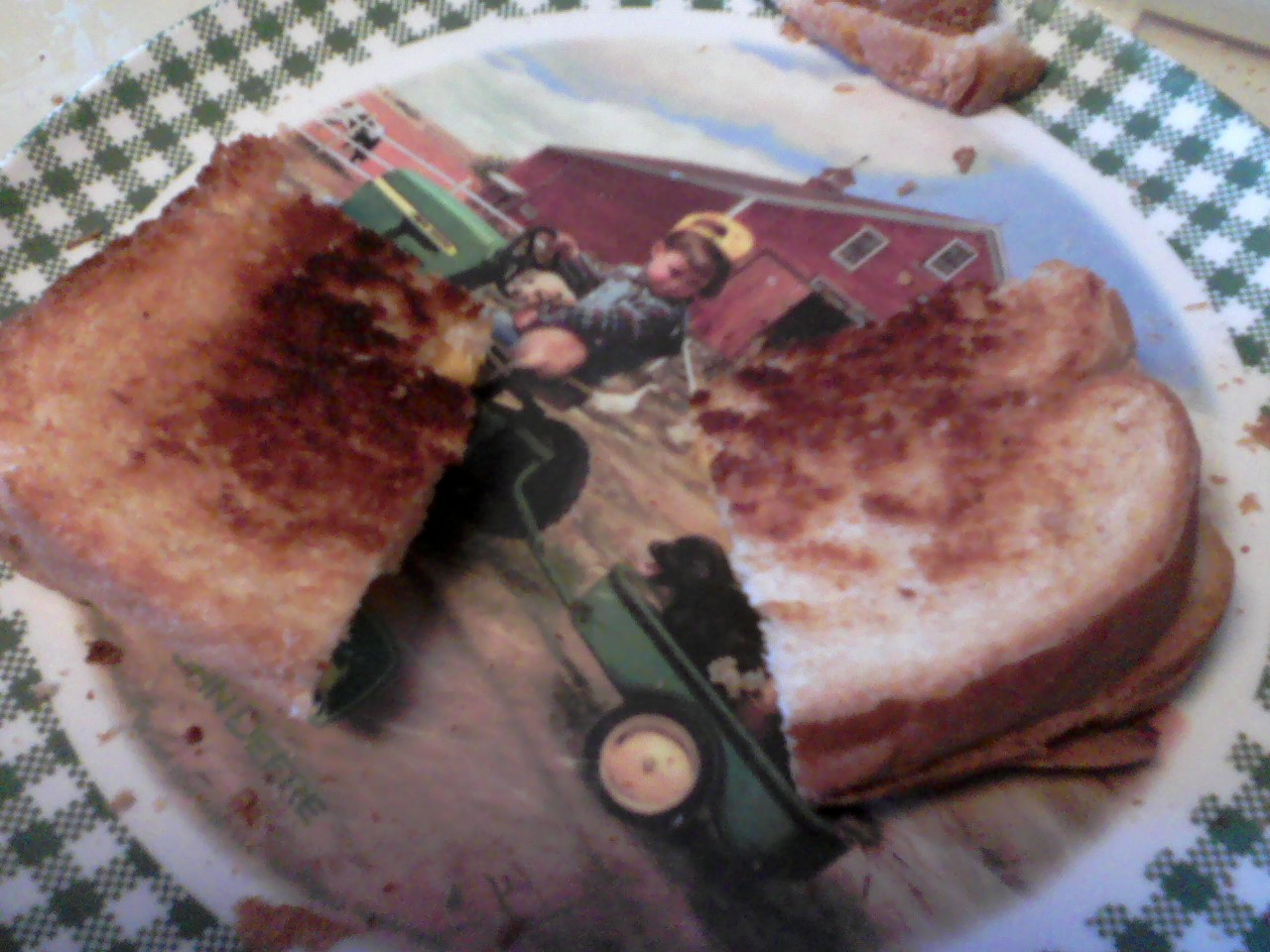
So, instead of having a grilled cheese for lunch, EJ had a sandwich with butter on the outside, cheese in the middle, and cooked in the frying pan. Who am I to argue?

EJs sandwich

No matter what you think, this is NOT a grilled cheese, just ask EJ.

That’s when the light bulb came on for me. Perhaps EJ just doesn’t understand exactly what makes up a grilled cheese, maybe he doesn’t get that I put just as much care and thought into making a grilled cheese as I do his other oddly-similar-to-a-grilled-cheese creation. But then again, he’s only 3, so chances are he’s just be stubborn and acting like a child.

But the same can be said for those that oppose animal agriculture. Maybe they don’t understand what is really happening on the farm, which is why I’m out here, in cyber-world, inviting questions, comments, showing videos, etc., trying to teach those that don’t know, what actually happens on the farm.

Maybe they don’t understand just how much of their day-to-day supplies and activities rely on those of us in agriculture…and not just animal agriculture, but all of farming. (If you’d like to take a look, you can check out some information on beef here: http://fitperez.com/2010-10-26-interesting-picture or here: http://www.beef.org or on agriculture here: http://www.csrees.usda.gov/index.html)

Maybe once there are more farmers/ranchers/agriculturalists out in the public’s eye, maybe then there will be fewer insults and ridicule, and more trust and compassion.

Or maybe some are just acting like children.

Interesting tidbit

Guess what’s the top-searched phrase that leads people to my blog? Nope, that’s not it, keep guessing.

Let’s just say that this little piece of information took me by surprise, but it’s got me excited about the opportunity.

The term that is searched the most and brought to my blog is….drum roll please…”humane society of the united states.”

Yep, you could have knocked me over with a feather. I mean, I talk about HSUS and my dislike for the organization as a whole, but it’s not a tag or a category that I use. Yet time and time again, that phrase brings people to my virtual doorstep!

What an opportunity!

So, to take this chance, let me tell you a thing or two about HSUS (or the Humane Society of the United States). They are NOT connected to your local shelter, at least not financially. According to several sources, less than one-half of one percent of their enormous budget trickles down to any hands-on animal care shelters. Yep, they don’t put their money into actual animals, just talking about them.

What they DO like to do is come into states, such as North Dakota, and tell people what it is they should care about. They twist words and play on emotions and make people afraid of the one thing they should trust in, that their food is safe, sustainable and abundant.

They spend ridiculous amounts of money on advertising and lobbying, in an effort to promote a meat-free future. They put forward money to help pass laws, such as California’s Prop B, but then seem to be missing in action when it comes to clean up the mess and figure out how to enforce a law that was passed by people that didn’t comprehend the science behind the practice to begin with.

Yep, the traffic that’s directed my way from that searched phrase is a blessing. I may be given just a word or two, or a sentence or two, or a paragraph or two to help shed some light on what life is like on THIS side of the dinner plate. And how we’re striving to do the best we can, for the benefit of not just our farm or our herd, but for the consumer as well.

And that’s not a job that I take lightly. For that, I’ll be forever thankful.

If you really want to make a difference in an animal’s life. Go to your local shelter and donate time, money or supplies. Not only will the staff thank you, but you may get an actual tail wag as well!

An open invitation

I think the activities of the last few weeks are kind of catching up to me. That’s the only way I can explain how I feel right now. I was going through some of my e-mails and other “office” type stuff when a tweet came across Tweetdeck that had a profound effect on me.

Normally, I don’t let these kind of things bother me too much, because if I did, I’d be crazy. But this was a link to the article that Time did on the high cost of cheap food. Basically it was a piece written by someone who sits behind a desk, has food at their fingertips and never again thinks about where his next meal will come from.

Here’s my challenge, or perhaps an open invitation, to these types of people:

Come, spend 24 hours fighting the wind, snow and ice of a driving blizzard, while trying to carry calves or herd cows into a barn, just so that they are safe and protected in the storm. Then sit at the computer when you get in, while wondering if you should lay down for a few minutes, or just head back out, and while at the computer, read an article that claims that you don’t do enough to provide safe food. Then you can complain about where your food comes from.

Now THAT's a snow bank!

Spend countless hours, weeks, months preparing to put your crop in. Spend every dime you’ve made in the last year, in hopes that you will make that, or maybe even a little more, in the coming year. Plant your seeds, watch it start to grow, take care of it the best you know how. And then watch as Mother Nature decides that she wants your crop…and have it wiped out in the blink of an eye. Then read about someone who thinks you should be happy enough with the fact that you’ll get paid a portion of what your crop was worth. That even though you have nothing to show for all of your hard work, it doesn’t matter, because you chose that line of work. That if you really wanted to, you could always get a job in town, never worrying about where food comes from, because the grocery store never runs out. Watch that unfold before your eyes…then you can complain about where your food comes from.

Put in a 20 hour day, working from before sun-up to past sun-down, taking care of whatever comes up during the day. Spend countless hours outside, loading bales by hand, helping a cow deliver a calf, fixing fence, changing tires. Then listen as someone on the radio claims that the crops you raise are going to cause our children to die at a younger age. That our country is fatter because of the unhealthy food that is grown. All while the same people are sitting behind a desk for eight hours, children are in school longer and in activities less, homework consumes all available time after school, as opposed to activities outside, menial labor is seen as substandard employment and fast-food is the king of family meals. Listen to that all day…then you can complain about where your food comes from.

All safe and warm inside, no matter what's going on outside.

Watch your son’s first ball game from a video tape, celebrate your wife’s birthday two months late, walk into church while the second hymn is being sung…all because a cow was calving and needed help, you had one more round to make before the storm let loose, or the crop needed to be planted, sprayed or harvested. Have your life played out around seasons, weather and all things that you have no control over. Work in those conditions…then you can complain about where your food comes from.

My family strives hard every day to make sure that our work ensures that the food we produce is the safest, healthiest and cheapest it can be for the consumer, as well as for ourselves. If we abuse our land, our animals or our crops in any way, then not only is our bottom line affected, but our whole lives are as well.

Fortunately, we live in a country where people don’t have to do any of the things I’ve wrote above, and still be able to complain…loudly and publicly. People attack an industry they don’t understand, because it’s easier to lay blame than to accept it. But the ag-community is responding. Perhaps someday soon there will be more articles in the national news thanking our farmers, ranchers and those that work hard so we can provide for all. Perhaps.

A girl can dream, right?