Points of clarification

So, apparently I finally rattled a few cages with my blog and my concern about what could all happen if this deer issue isn’t addressed somehow. But a few questions keep coming up, so I’d like to clarify a few things:

1) Is our land posted? The answer is yes. I know that by admitting that, many will say that alone is our problem, but trust me, it’s not. There is only one person that has ever asked to hunt that we have turned away. In fact, I’ve brought in many hunters…and not just for deer. We open our land to pheasant hunters (out-of-state and in-state), youth hunters (two of my nephews tagged deer out of our land this fall!), etc. Pretty much anything, anyone. We do NOT charge anything to hunt on our land and we wouldn’t post our land either, if it weren’t for the few bad actors that we have. Actually, we shouldn’t even have to post our land, since our cattle were in one area, and the other hunting area is behind our house…but we do anyway. And as long as people are aware of the cows, and aware of the house and children, then I have no problem at all with them hunting and taking whatever game they legally can.

2) The problem is not just the deer…although they are making a mess as well. The problem is also that there is another significant creature that follow the deer. That is the coyote. The coyote is a predator, and our cows don’t take too kindly to having coyotes nearby. Now, add in a cow that’s just had a calf, the fresh blood and afterbirth smell lingering in the air, a cow nervous about making sure her calf is safe and a farmer trying to get the calf into a barn before it freezes to death. That, right there, is a recipe for disaster. Our cows are gentle and are accustomed to us walking through them throughout calving season. But once a cow has a calf, it’s like a switch is flipped.

A good cow has a good mothering instinct. A good mother protects her offspring with whatever means are necessary. If a cow senses that its calf is in danger, it will do whatever it deems necessary to protect it. That includes throwing a farmer over a fence…or worse yet, a farmwife!

3) Deer poop. Yeah, I know, that’s a shocking revelation, right? Well, they also pee. Cows don’t like either…especially on their food. So, this means that everything that gets deer poop or deer pee in it is basically useless. And really, who can blame them? I have a hard time eating off the same spoon as my kids, I couldn’t imagine anything else! (Just kidding, by the way.)

So, that should cover some of the questions that were asked (but please, feel free to ask more if you have them!)…let’s hope they get us somewhere!

Ever increasing problem

We have a “small” problem on our farm. I call it a small problem, because the animals themselves aren’t all that large, but the number in which they are here…that’s where the issue lies.

Last year it started as a nuisance. I warned Boss Man that I thought the deer around our house seemed to be getting closer and closer, and seemed to bring their extended families with them. At first, he kind of brushed off my concerns, saying that they had never really bothered the hay before and that they would probably move on shortly.

They didn’t.

In fact, they seemed to rather enjoy themselves, and made themselves right at home. As you can see here: (Warning, this is the first video I had ever shot, so please excuse the nausea-inducing zooming and movement…I’ve learned…well, at least a little.)

This year is a whole new ballgame. We have already enrolled the help of our state Game and Fish, who have come up with some interesting tactics. (For instance, a really neat gun-looking, bottle-rocket-on-steroids type thing!)

To explain it from my husband’s point of view, I’ll just give you the run-down of a conversation we had:

“It’s a double-edged sword. If they eat my hay, they won’t starve. They’ll be stronger and healthier, but then they’ll also survive winter and there will be more next year.

“If they don’t eat my hay, they’ll starve. But they’ll be weak and more susceptible to disease, exposing my herd to who-knows-what.”

And this is what we’re talking about for this year:

So, you see, we’re in a tough spot. If we don’t feed the deer, they will get sick and die. But may expose our cows to all sorts of unwanted stuff.

If we feed the deer, they won’t leave, and could still get sick and die. And we will still have exposure to whatever it is they are carrying.

We have already spent money on buying panels to place all around our feed, such as the silage that we cut and the freshly-ground hay. Game and Fish suggest that we space our hay stacks closer together, but our insurance insists that our hay stays further apart. I personally don’t believe that where our hay is located would make much difference to this large number of animals.

The amount of money that has been lost through the hay and feed that has been destroyed is almost nauseating. But the danger to the health of our herd is what has us the most concerned. We are doing all we can to protect our livestock, but it would be nice if there was a better system in place to assist producers that come across these issues.

Trust me, this is something that Boss Man and I will be working on.

An open invitation

I think the activities of the last few weeks are kind of catching up to me. That’s the only way I can explain how I feel right now. I was going through some of my e-mails and other “office” type stuff when a tweet came across Tweetdeck that had a profound effect on me.

Normally, I don’t let these kind of things bother me too much, because if I did, I’d be crazy. But this was a link to the article that Time did on the high cost of cheap food. Basically it was a piece written by someone who sits behind a desk, has food at their fingertips and never again thinks about where his next meal will come from.

Here’s my challenge, or perhaps an open invitation, to these types of people:

Come, spend 24 hours fighting the wind, snow and ice of a driving blizzard, while trying to carry calves or herd cows into a barn, just so that they are safe and protected in the storm. Then sit at the computer when you get in, while wondering if you should lay down for a few minutes, or just head back out, and while at the computer, read an article that claims that you don’t do enough to provide safe food. Then you can complain about where your food comes from.

Now THAT's a snow bank!

Spend countless hours, weeks, months preparing to put your crop in. Spend every dime you’ve made in the last year, in hopes that you will make that, or maybe even a little more, in the coming year. Plant your seeds, watch it start to grow, take care of it the best you know how. And then watch as Mother Nature decides that she wants your crop…and have it wiped out in the blink of an eye. Then read about someone who thinks you should be happy enough with the fact that you’ll get paid a portion of what your crop was worth. That even though you have nothing to show for all of your hard work, it doesn’t matter, because you chose that line of work. That if you really wanted to, you could always get a job in town, never worrying about where food comes from, because the grocery store never runs out. Watch that unfold before your eyes…then you can complain about where your food comes from.

Put in a 20 hour day, working from before sun-up to past sun-down, taking care of whatever comes up during the day. Spend countless hours outside, loading bales by hand, helping a cow deliver a calf, fixing fence, changing tires. Then listen as someone on the radio claims that the crops you raise are going to cause our children to die at a younger age. That our country is fatter because of the unhealthy food that is grown. All while the same people are sitting behind a desk for eight hours, children are in school longer and in activities less, homework consumes all available time after school, as opposed to activities outside, menial labor is seen as substandard employment and fast-food is the king of family meals. Listen to that all day…then you can complain about where your food comes from.

All safe and warm inside, no matter what's going on outside.

Watch your son’s first ball game from a video tape, celebrate your wife’s birthday two months late, walk into church while the second hymn is being sung…all because a cow was calving and needed help, you had one more round to make before the storm let loose, or the crop needed to be planted, sprayed or harvested. Have your life played out around seasons, weather and all things that you have no control over. Work in those conditions…then you can complain about where your food comes from.

My family strives hard every day to make sure that our work ensures that the food we produce is the safest, healthiest and cheapest it can be for the consumer, as well as for ourselves. If we abuse our land, our animals or our crops in any way, then not only is our bottom line affected, but our whole lives are as well.

Fortunately, we live in a country where people don’t have to do any of the things I’ve wrote above, and still be able to complain…loudly and publicly. People attack an industry they don’t understand, because it’s easier to lay blame than to accept it. But the ag-community is responding. Perhaps someday soon there will be more articles in the national news thanking our farmers, ranchers and those that work hard so we can provide for all. Perhaps.

A girl can dream, right?

Par for the course

Winter reared its ugly head just in time for Thanksgiving. But that didn’t stop us from making the 2 1/2 hour trek to Fargo and spend the day with my sisters and their families, as well as shopping for a whopping 19 hours straight on Friday! I tell ya, having four boys does get me in training for some of the finer moments in life!

We came home Saturday and enjoyed a lazy day at home. Then I took my foster-Grandpa to bingo (his favorite thing to do) and enjoyed a quiet night without the kids at home. Woohoo! (They stayed at my Mom and Dad’s.)

On Sunday, we planned on being in church, which starts at 10. Boss Man left the house at 8-ish, thinking he would have “plenty” of time to feed the cows and get the chores done prior to having to leave by a little after 9 (remember, our boys are at my folks’).

Well, I should have known that things wouldn’t go as planned. The morning went in typical fashion. Boss Man pulled back into the yard with the tractor at 9:40. It’s a 15 minute drive to town and we don’t have our boys yet. Plus, I still have their church clothes with me at home. So, needless to say, the cows won that one and we weren’t able to go to church. But, I did get the boys to Sunday School! Yay for a small victory!

Then last night EJ managed to turn a pen and a plastic tube from a toy into a lethal weapon and punctured a hole above his tonsil. Yep, that’s how I roll.

Cheers to 2011!

A Thankful Heart

It’s the week of Thanksgiving, and I have so much to be thankful for, that I should have started last week! But I’ll get around to all the thanking I need to do, it’ll just take some time.

First off, I’m so very, very thankful for my boys, my husband and the rest of our family. Even when insanity is at its highest, there isn’t a moment that I don’t realize just how lucky I am. Last week one evening, Big Bro came home from school and as we were working on his homework he said to me, “You know Mom, I’m so glad that I have you. I’m a pretty lucky kid.” After wiping away the “dust” in my eyes, I told him that I was the lucky one. And I am.

Second, I’m thankful to be living in a country so great that we have the freedom to choose so many aspects of our lives. We can choose who we want to be, what we want to do, where we want to go and how we get there. (Even if it means the discomfort of an up-close-and-personal pat down!) These choices are ever-present and sometimes overwhelming, but I’m thankful for them none-the-less.

I’m thankful for my fellow farmers and fellow ag-related friends. The amount of time and dedication that goes into agriculture-related fields is amazing, and it truly becomes not just a job, but a way of life. To the point that trying to imagine your life outside agriculture is on level with trying to figure out which of your children is your favorite, it’s just not possible.

I’m thankful for the food that is produced by ALL of agriculture. Organic, no-till, conventional, cage-free, free-range, traditional, grass-fed, corn-fed, grain-fed, whatever the buzz word of the day is, whatever your production methods may be, the world needs it all. As long as people are going to bed hungry at night, as long as children wonder where there next meals come from, whatever it takes, we need to keep producing the safest, most cost-effective food source possible.

And I’d be really thankful if I had a tongue long-enough to lick the inside of my nose! (Just kidding, of course)

Don't you wish you could lick the inside of your nose with your tongue?

Making it personal

So, one of the big pushes now is local food. And I’m all for it. If you can buy your food locally, more power to you. Support your local farmers, support your local growers, support your local stockmen. But what about those who can’t?

I’ve wasted spent time this afternoon trying to get a figure on how this would work in North Dakota. And boy, can you find numbers for just about anything if you’re really looking! But I digress.

According to several studies, the average person consumes 67 pounds of beef per year (to make this easier on myself, I just included beef, but I could look into chicken/sheep/hogs/etc.). The average feeder (usually a steer (bull calf castrated))  produces roughly 350 pounds of meat for consumption. (Again, those numbers can jump all over the place, but this is a pretty good average.)  So, if we can agree on these numbers, that would mean that an average feeder would feed 5 people in one year. Are we on the same page still?

Well, let’s look into that. Let’s say this whole push for local food become mandated (don’t laugh, we’re heading that direction if not careful). I decided to look around North Dakota and see how we would fare.

Just for this scenario, I kept everything within county lines. As in, pretending that a law had passed that made it impossible to buy meat that wasn’t raised within your county. (I had to start somewhere, and it made the figuring a little easier…although still pretty time consuming!)

I started with Dickey County (where we live). And we would actually fare pretty well, although that’s not too surprising, since we only have a little over 5,000 residents in the whole county. We only need roughly 1,043 head of cattle (fit for consumption) to feed our county for a year. According to the 2007 USDA Census of Agriculture put together by the National Agriculture Statistics Service, Dickey County has 49,937 cattle. Now, that includes all cows, calves, bulls, etc. But no matter how you look at it, we could feed our own. Way to go Dickey County!!! Woohoo!

But let’s look a little more populated. Let’s check out Fargo. Guess what? Yeah, apparently we’re going to need to set up some sort of “food panel.” The Fargo metro area boasts approximately 200,102 people in 2009. Which means that it would take approximately 40,020 head of cattle to feed them for a year. Guess how many cows are in Cass County? According to the USDA, there are just over 12,000. So who isn’t going to eat?

Now, don’t go jumping to conclusions that going vegetarian is the answer. We don’t have enough land for that either. We currently raise cattle on land that, for the most part, isn’t suited to grow crops. So we’re already growing crops on whatever land is available to do so. And in spite of all of our efforts, people in our country are going hungry each and every day.

Buying local/growing your own is a great alternative for those that it works for, but it’s not for everyone. The numbers don’t work, no matter how you look at it. Agriculture as a whole is needed to feed not just the world, but our own country and our own neighborhoods. We need to work together and realize that one alone does not stand. It’ll take all types, all kinds, all methods to be able to feed our ever-growing population on our ever-shrinking acreages.

Do the math. It doesn’t figure any other way.

Fantastic fall footage

I put together a video of chopping corn, but never posted it to my blog. Thanks to the wonders of YouTube, more than 100 people have found their way to it! LOL! But I meant to post it, so I still will…if you’ve already seen it, enjoy it again, or go check out some of my other videos. (Including one with the live birth of a calf!)

To explain the process, once corn reaches the stage at which boss man feels it would be ready to cut (or when we have help available!), we set out with the Gehl’s and start the job. The choppers cut the corn into bite size pieces, that will be mixed with ground hay and wet cake to make a yummy cocktail for our calving herd throughout the winter and spring.

The corn is dumped on a pile that is driven over, and over, and over by a big 4-wheel drive tractor. This packs it and makes it easier to cover and prevents extensive spoilage.

The chopped corn smells sweet. I, personally, am not a big fan of the smell, but my sister loves it! It’s just a part of fall.

The pile is covered with a thick plastic, part to prevent spoilage and part to prevent damage and loss from deer. Deer were a MAJOR problem last year. We had a herd of probably 200-300 deer that decided that our hay yard and feed were a GREAT way to spend the winter. They made a mess of everything, so this year we’re trying to nip that in the bud and make sure we’re prepared. (You can see the video on YouTube, if you check out some of my videos that I’ve posted. It’s not a great video, since it was my first ever, but you get the point.)

We’ll start feeding cows in the next few weeks. It will depend on when snow covers the ground and we’re able to get the cows moved home. It’s time to admit that winter is almost here!

Welcome to our herd

A few weeks back, I promised to explain the history of our herd…and I thought today would be a great time to do that!

As I had mentioned a few weeks back, our herd is what would be considered a closed herd. My husband explains it this way: “Well, the only new women on this farm were you and Mom.” Yeah, he has a way with words.

Basically, every cow on this farm is traced back to another cow on this farm…all the way back to the original herd started in the 1950’s. The only new blood (necessary, to prevent in-breeding and defects) on our farm are bulls that are bought periodically. We also use artificial insemination…but I’ll get into that in the future.

Now, this type of ranching may not work for others, but it works for us. We are able to trace back any genetic issues, match up heifers to better bulls for their ease of calving, and have a very detailed history of each calf that is born on our farm.

So, our herd started out as polled Herefords…and now we are Red Angus with Simmental cross. We changed things up when we needed to, made careful choices throughout our history and were able to survive through today. That, in itself, is something to be proud of!


This is an example of a polled Hereford.


It also goes to show that agriculture isn’t just about setting a goal and being strict in your path to get there. Sometimes along the way you need to be willing to veer off the path and try something new, be willing to be flexible and willing to work with whatever is thrown your way.


This is our herd today.


And with four boys coming up, I’m hoping that there will be at least one new woman coming my way!

They can sense it…I know it

Our bulls have ESP…I just know it.

Yesterday boss man pulled out of the yard with the semi to go get a load of hay from our land about 20 miles west of here. Just as he pulled out of the yard, the bulls headed west across our alfalfa field to take a little walk.

They pretended the fence wasn’t even there and just kept right on walking. And there was nothing I could do about it. I don’t know if they enjoy watching my little mini-van trying to round them up, or they just like to make me seem like a crazy woman who can’t stand to see her husband leave the yard, but whatever it is…it works.

By the time boss man got back to the yard, they were mostly back in, making it seem as if I had either a) dreamed up the whole thing, or b) over-exaggerated the whole escape. The answer was closer to c) the bulls are trying to drive me over the edge.

Sad thing is…they’re beginning to win!

And the tag means???

I had a question asked of me on Twitter today, or should I say I answered one that was being discussed. Someone was wondering how we decide what tags go on which cows. I had never thought of it before. Sometimes, when you’re on the inside, things seem so obvious that you forget that others don’t know why you’re doing it…it’s an epidemic in agriculture, and one we’re working on fixing.

To answer the question, yes the tag does mean something. When calves are first born (or at least soon after), they get a tag in their ear with the same number their cow has. The white tags mean that the calf is a bull, the yellow tag means that it’s a heifer (a female that hasn’t had a calf yet).

Separating the two sexes of calves helps make giving the calves their vaccinations easier. Plus, you don’t have to worry about trying to castrate a heifer! 🙂

Purple cow

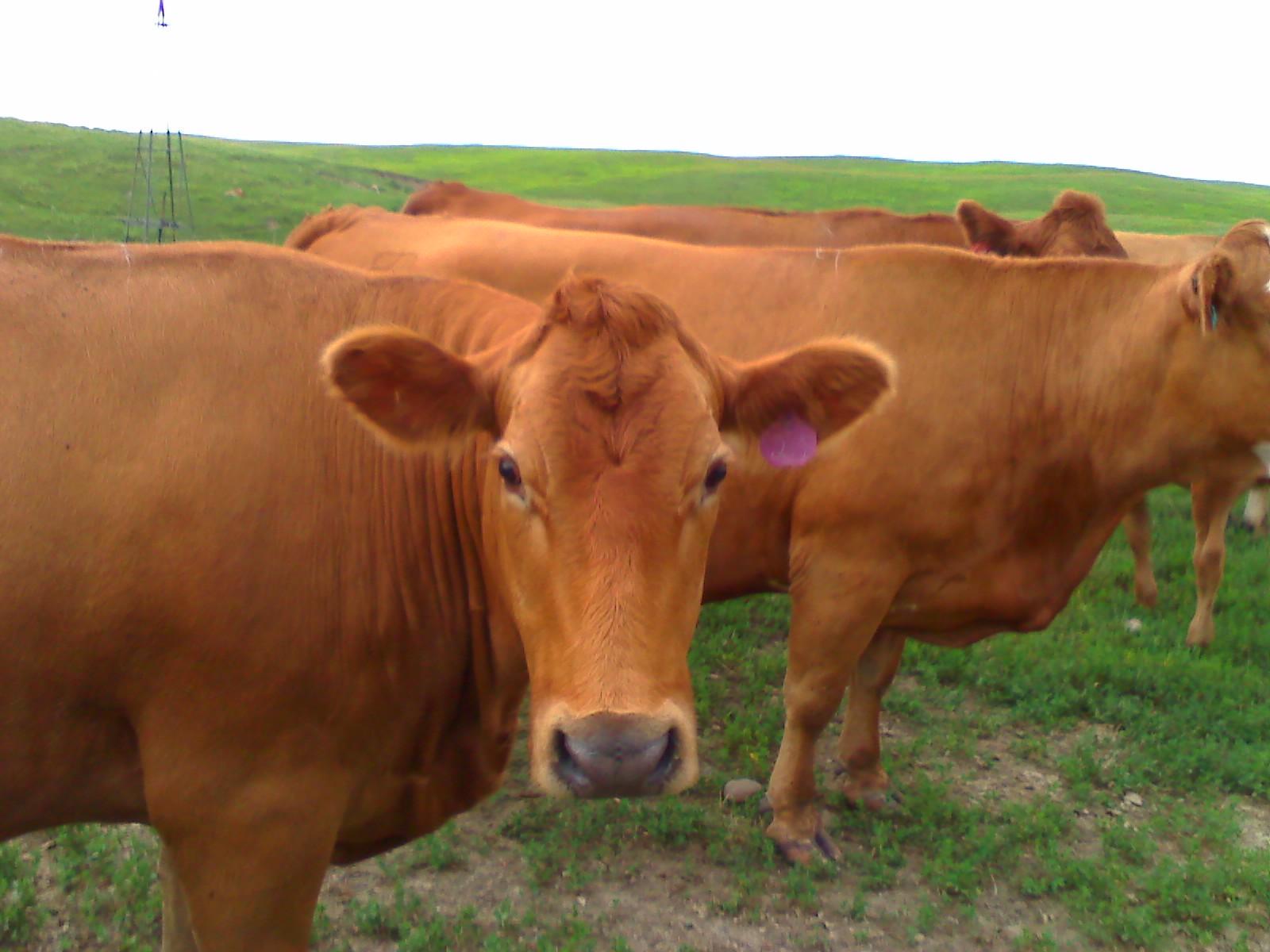
This cow has a purple tag, you can see the one in the background has a blue tag.

Now the cow tags are different colors for a different reason. Each year the cows get a different color ear tag. Tags come in tons of different colors, so it works pretty well. Cows are normally only on the farm for 10-12 years, as long as they have a calf, they stay. You can look at the cows tag and know which year she was born in. (We have a closed herd, which means every cow that’s on our farm was born and raised here…I’ll explain that more in another post some time.)

Another benefit of having different colors is so that you can easily determine which cow you need to bring in (sometimes looking at a sea of red faces is confusing, but the color of the ear tag helps), during calving season…or any other time of the year, if there is a health issue.

There’s a lot more to it then that, but that’ll do for now. I don’t want to overwhelm you with cow information!

If you have any questions, please, feel free to ask. I love talking about our farm…and I’ll gladly take a video or some photos to help out the process! 🙂