
To buy or not to buy organic? That is the question.
But why does it have to be?
I thought about this question alot, while preparing this post. In fact, most of my posts are written in a very short amount of time, usually 10 minutes or less. Sometimes it’s as if the words were already there, I just needed to type them out. But not today.
As a farmer, I am proud of almost every aspect of agriculture. I truly value the organic movement, because anything we can do to continue to provide food is important. We NEED every farmer, every type, every size, to continue providing food for our world.
Over the weekend, a slideshow by WebMD was brought to my attention. At first, I was kind of excited about it…hoping it was going to put to rest some of the myths and misconceptions surrounding conventional and organic foods. But it didn’t. In fact, it went a step or two further than most articles. And I feel the need to set some “facts” straight.
1) It was stated in the slide show, that fruit and vegetables such as apples and peaches should be bought organic whenever possible, to reduce the exposure risks of pesticides. The site said, “If you can’t afford to buy organic apples, scrubbing their skins under running water can help reduce pesticide residues, too.”
Well, to tell you the truth people, no matter where you get your apples, you should ALWAYS wash them. Period. The same is true for organic, just as it is conventionally grown fruit and veggies.
2) Directly quoted from WebMD, “According to the Organic Trade Association, livestock on an organic farm cannot be given antibiotics or growth hormones unnecessarily — a common practice in conventional agriculture. Some experts think using antibiotics this way may contribute to the rise of superbugs. And although the risk to humans isn’t clear, added hormones do show up in supermarket beef.”
Let me shed some light on what happens on our farm (since I can’t speak for everyone, but know that most follow the same type of protocol). We give antibiotics only when necessary, such as when an animal is showing sign of being sick. We would never consider giving all of our animals antibiotics on a set schedule for many reasons, including: a) cost, b) time and feasibility and c) we need those antibiotics to work when we truly need them. To say that most conventional ranchers use antibiotics unneccessarily is simply not true.
And on the hormone subject…let me break down the actual facts for you:
4 oz. beef from steer given hormones: 1.6 nanograms of estrogen
4 oz. beef from untreated steer: 1.2 nanograms of estrogen
4 oz. beef from non-pregnant heifer: 1.5 nanograms of estrogen
4 oz. raw cabbage: 2700 ng estrogen
4 oz. raw peas: 454 ng estrogen.
3 oz. soy oil: 168,000 nanograms of estrogen
3.5 oz. of soy protein concentrate: 102,000 nanograms of estrogen.
3 oz. of milk from cow given rBST: 11 nanograms of estrogen
3 oz. of milk from untreated (non-BST) cow: 11 nanograms of estrogen
Data from Foodstuffs Foodlink
Hmmm…so those extra hormones are a problem, but raw peas have 400% more estrogen in them. Perhaps we need to lay off the peas? I’m kidding, of course. That would be obsurd. Right?
3) This one I found funny. Broccoli. Yep, you should grow your own organic broccoli. Have any of you grown broccoli? I have no problem with growing your own food, even broccoli. I just appreciate the ability to choose not to. I don’t like the extra protein.
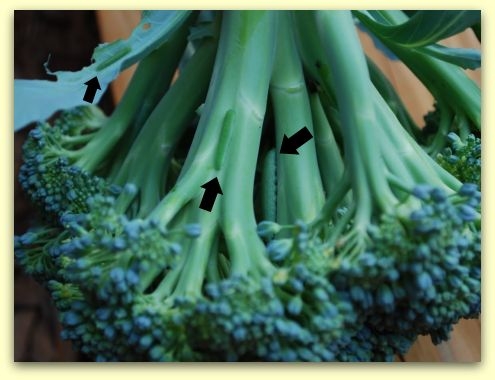
Mmmm...worms.












 Wag'n Tales