What makes a constitutional amendment?

As I’ve made perfectly clear in the past, I am in favor of Measure 3, the North Dakota Constitutional amendment that would protect farming and ranching and modern practices employed by farmers and ranchers.

I want to address one of the concerns that is being brought up by the only vocal agricultural group in opposition to this measure…the North Dakota Farmer’s Union.

First of all, as a member of Farmer’s Union (I’m a member of Farm Bureau as well), let me tell you that I’m extremely disappointed and concerned regarding the stance they have on this measure. It’s becoming more of a school-ground bullying match than fact-sharing, and it’s not what being in agriculture is all about.

Enough about that, let’s get to the issue. Opponents of the measure keep declaring that the constitutional amendment is too vague. Practices aren’t specified and there are no restrictions for negligence.

Why did I highlight constitutional amendment? Because that’s what this is…a change to our state constitution, that would protect the heritage that makes North Dakota the great state that it is, that provides food, fiber and fuel for the world.

The amendment needs to be broad enough to stand the test of time, allowing society to advance and our state constitution to stay current, even when we can’t imagine what the next century may bring.

Let’s take a look at another constitutional amendment:

A well regulated militia being necessary to the security of a free state, the right of the people to keep and bear arms shall not be infringed.


Wait a minute…how could that amendment have been passed? It doesn’t state that you can’t use weapons negligently. It doesn’t state that you are limited to muskets and cannons only. So, surely, it must have been voted down and didn’t stand the test of time, right?

How about another one:

Congress shall make no law respecting an establishment of religion, or prohibiting the free exercise thereof; or abridging the freedom of speech, or of the press; or the right of the people peaceably to assemble, and to petition the Government for a redress of grievances.


Geez, that one didn’t pass either, did it? I mean, it doesn’t specifically state that I can’t call someone a few choice words in a newspaper ad that runs across the country. Oh, wait…but I can’t, can I? Not without the other person having legal recourse.

No, constitutional amendments are NOT about specifying exactly what it is you can or cannot do, it’s about upholding the wishes of the people of the state, for generations to come. It allows flexibility for growth and changes that are made by society, yet it protects the basic rights that we should be entitled to…and that includes our agricultural heritage.

With these rights come expectations, regulations and limitations, it does not, nor will it ever, trample on the rights and freedoms of others. It allows for the legal protection of our way of life and direction for those that are making the laws that will govern our future societies.

Please, do not tell me that Measure 3 is too vague in its wording, and needs to have specifics put in place.

Although, all I can do is ask, because there’s already an amendment that allows you that right.
Yes on North Dakota Measure 3

Did you know that America’s farmers and ranchers produce 16 percent of the total world food production on just 10 percent of the world’s land?

Agriculture and related industries provide jobs for more than 21 million Americans. That’s 15 percent of the total U.S. workforce.

In 1940, each U.S. farmer annually fed approximately 19 people in the U.S. and abroad. In 1960, each farmer feed about 46 people. In 1980, 115. In 2000, 139. Today, each U.S. farmer feeds approximately 154 people here and abroad. And they are doing it with fewer inputs, and on fewer acres.

Farming and agriculture is the backbone of our country, but more importantly, it’s the number one industry in North Dakota. Long after the oil boom has come and gone, farming will still be growing our economy and providing for our state and our country.


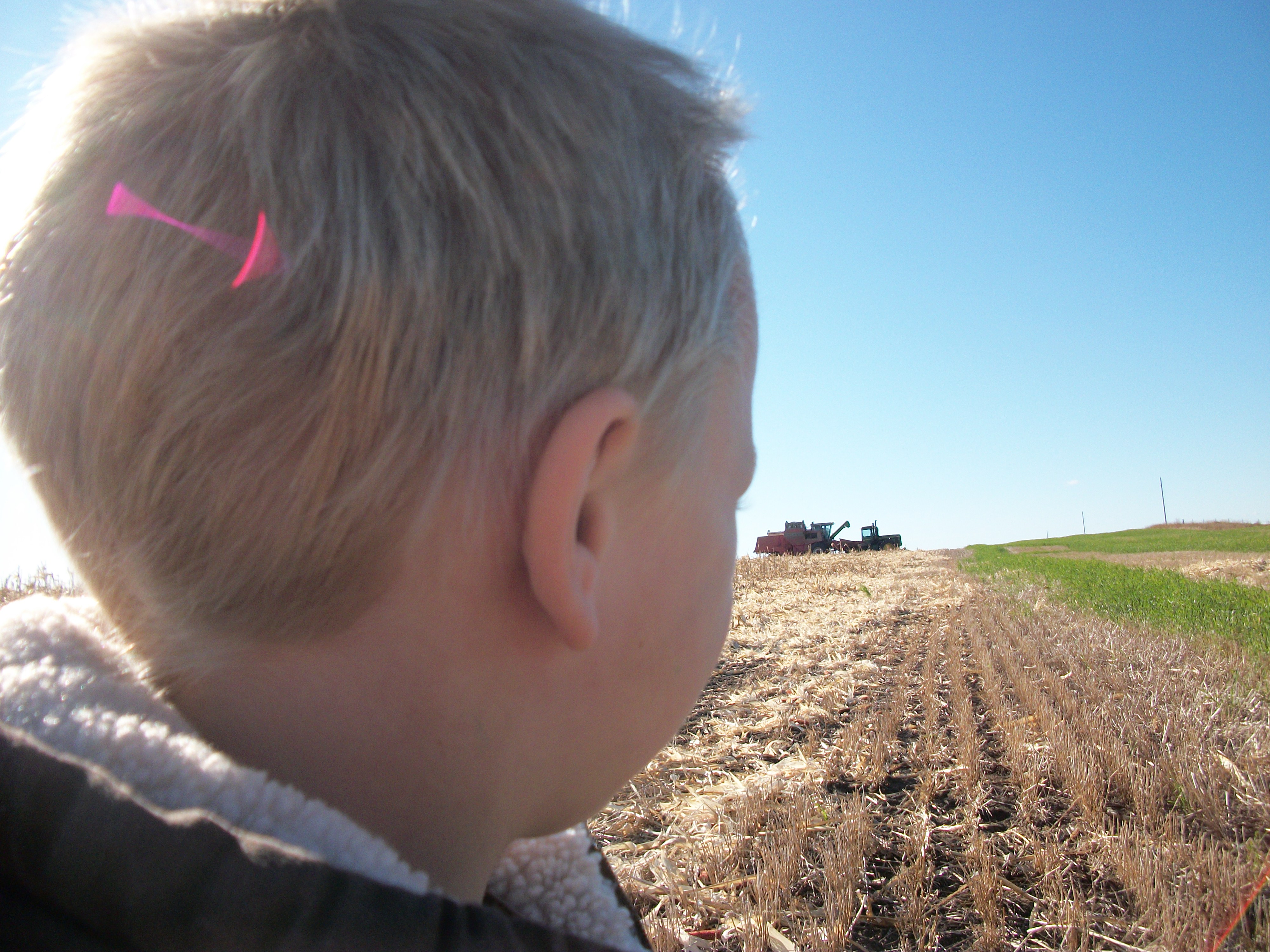
Waiting his turn…his dad is in the tractor, his grandpa is in the combine. Is his future in jeopardy?


Measure 3 is a constitutional amendment that will ensure that out-of-state interests and activist groups will not be able to pass ballot initiatives that would jeopardize our heritage of agriculture. This measure would protect the way of life that has made North Dakota a great state and a great place to raise a family.

But there are misconceptions about what this measure is about, and we’d like to clear those up. This measure is NOT about farming systems, it doesn’t pit organic versus conventional or large versus small. This measure would ensure that if you wanted to use GPS and auto steer in your tractor, that would be allowed. You would be allowed to raise livestock of your choosing without worrying that some out-of-state feel-good group is going to tell you that your buildings or fences are abusive to the animal. You would also be allowed to make your own individual seed and chemincal choices on your farm, including heirlooms, biotechnology, organic or conventional. A law could not be passed determining what is right for all farms in North Dakota, those decisions would be left to each farm to make.

The measure is NOT about removing local control. It would not limit local zoning ordinances, nor would it remove the power from local and state governments for regulations.

Measure 3 IS about allowing farmer’s markets and other niche consumer activities to continue to grow and prosper, it’s about giving people choices and protecting our past, present and future. The constitutional amendment is intentionally broad enough to stand the test of time, yet focused enough to protect what North Dakota holds dear.

For those that would question whether regulations would still be allowed, we give you an example of another constitutional right. We have the right to bear arms, but with that right also comes limitations, responsibilities and regulations. The same is true for agriculture.

We just want the right to farm, without risk of having someone else from out of state taking that right away.

Our kids aren’t as fat as you think

Whoa. That’s quite the title for a blog post, isn’t it? Here are some other versions I tossed around, “How to make research fit your agenda,” “Misleading the public: Our way or the highway,” “It’s only a few percentage points…who’s gonna notice?”

So, what’s my point? I’ve been reading and researching the 81 pages of the new school lunch guidelines. I’ve read the comments left, I’ve read the “White House Task Force on Childhood Obesity” report. I’ve started to have dreams regarding statistics…and I hated statistics in college. Hated.

What did I learn? I learned that although the powers that be keep using the number “1 in 3” as the percentage of obese kids in our country, well, that number isn’t right. In fact, we’re off by quite a ways. How far? Try about 14%, give or take.

Everywhere you look, you’ll read the statistic that 1 in 3 children are obese. In my mind, that means roughly 33.33%. Again, I wasn’t a math major, so if I’m wrong, please correct me. (And no, I don’t mean just take it out a few more decimal places. 😉 ) What if I tell you that the number is actually closer to 19%? Would that matter?

Well, that’s the truth.

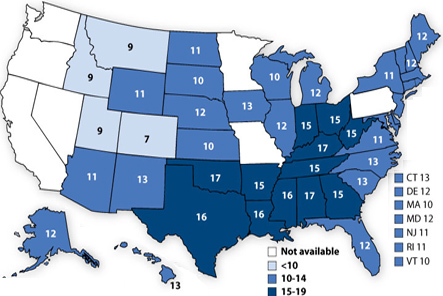
This is percentage of high school students obese, according to the CDC.

Here, read the CDC’s stats directly from their page: “The percentage of children aged  6–11 years in the United States who were obese increased from 7% in 1980 to nearly 20% in 2008. Similarly, the percentage of adolescents aged 12–19 years who were obese increased from 5% to 18% over the same period.” (The number in the White House report bounces between 17% and 19.6%, depending on which graph you want to look at.)

So how can they get away with it? Simple. It’s a matter of word choice. In the above report, the next line reads, “In 2008, more than one third of children and adolescents were overweight or obese.” It goes on to explain that “overweight” is defined as having excess body weight for a particular height from fat, muscle, bone, water, or a combination of these factors. Obese is defined as having excess body fat.

So, when someone is making a statement, or a report, or a news conference, it’s just more newsworthy if you drop the “overweight” part off and leave it as “obese.” But the two terms are not interchangeable. There are so many factors that can weigh in on a child’s weight, not just activity level and diet. What about injuries? What about stress? What about extending health issues?

What causes an overweight child? Here are a few examples: Imagine a high school student, very active, with an injury that requires months of rehab. They continue to eat as they’re used to, but realize they need to make some diet adjustments once they start noticing a few pounds being added on. The pounds drop again once activity is resumed.

Or what about a teenage girl, just transitioning into her cycle. Weight fluctuates greatly, revolved around hormones and other things that occur as the body makes great changes. Same is true for boys as they hit puberty.

No, an overweight child is nothing to scoff at, but it’s also not something to legislate for…it’s a natural occurrence in the life cycle.

But obesity, well, obesity is a little different. And although we do need to take steps to make improvements, the majority of the differences need to be made at home. And that’s not a place where legislation reaches…at least, not yet.

By law, we are not required to buy fruit. By law, we are not prohibited from purchasing soda. By law, we are not limited to the number of times pizza can be served as a meal.

As parents, we need to make the right decisions for our children, that includes after the bell rings.

If we truly want to drop the obesity rate in our children, we can’t expect cuts to the school lunch program to be the smoking gun. School lunch was never the root of the problem.

But we also can’t go around making changes, touting stats and bending the information to fit our goals. Some may not take the time to read the fine print, but when you get caught using misleading numbers, I start to question the rest of your agenda as well.

I applaud the new fruits and increased use of vegetables in our school lunches, I love the new recipes and new twists on the old-standby’s. Yet calorie caps and protein limits will not succeed to achieve a goal that’s been misquoted in the first place.

Can we work together to make real change?

Protecting ALL animals – Vote NO on Measure 5

North Dakota is an agricultural state. No matter what happens in the west with the oil boom, agriculture will still be here for generations to come…if we protect our heritage.

There is a measure that will show up on the November ballot that can put all of that at risk, and it’s up to us, the citizens of our great state, to stand up and let others know that we fully support and wish to protect our legacy.

What am I talking about? Measure 5 is a poorly worded, narrow-focused measure that has been crafted by an out-of-state animal-rights group that has a history of coming in with big guns, lots of money and slick ads, changing state laws and then pushing anti-farming, anti-hunting and pro-vegan agendas. All while making you feel warm and fuzzy that you’re helping little kitties and doggies.

Do you know how much of the Humane Society of the United States’ budget goes to truly help hands-on pet shelters? Less than 1 percent of the multi-millions that are in their budget. The rest is spent on pensions, lobbying and suing others to make them follow their guidelines.

We cannot let a group such as this in the door.

Let’s take a closer look at the measure, not just the people behind it.

To start with, the measure only addresses horses, cats and dogs. Why would that be? Well, it seems pretty plain to me that they’re aiming at easy targets for an emotional argument. It’s a great marketing ploy. If you were to set my dog on fire, you better believe that I want you to see jail time. In fact, jail is probably the safest place for you, because if I have an opportunity to inflict harm on you, well, I may face a little jail time myself.

Hurt one of these little guys maliciously, and you better hope you’re in jail, where I can’t get a hold of you. Yet, she’s not included in the measure.

But the same is true for my cows. And they wouldn’t be protected under the measure.

Another problem I have with the measure is the scope of “crimes” that it addresses. Here it is directly from the measure: “Any individual who maliciously and intentionally burns, poisons, crushes, suffocates, impales, drowns, blinds, skins, beats to death, drags to death, exsanguinates, disembowels, or dismembers any living dog, cat, or horse is guilty of a class C felony.”

I agree that all of those things are cruel, malicious and worthy of jail time (or worse), yet those things rarely happen in our state. In fact, when you search for crimes like these in reports, you have a hard time finding any at all.

Yet, the most common types of cruelty are not addressed. Things such as starvation and animal hoarding, which cause much more distress and harm to the animals, aren’t even mentioned. Why? Perhaps because a law such as this would seem to be a no-brainer, but once we let HSUS in the door, we’re open to litigation, interpretation by the courts and forced to defend those things that should be seen as protected rights.

I’m not asking people to just vote “No” and call it a day. There is a group of people that have worked hard to come up with an alternative that could be passed legislatively, making it easier to adjust as concerns come up and easier to amend when times change.

Let’s send the message that we don’t need out-of-state interests coming in to our state and telling us what to do and how to treat our animals. The scare tactics they use to push these measures is almost laughable, if it weren’t happening right here.

Defeating this measure is not going to be easy. When their advertising revolves around cute cats and puppies and ignores the issues surrounding the measure, it’s pretty plain to see what we’re up against.

We love our cats…and our dogs…and our cows. But Measure 5 is not the right answer, for any of them! Vote NO!

I love my dogs, I love our cats…but I also love our cows. Voting “No” is not a vote against our pets, it’s a vote for common sense and a vote for the future of agriculture.

Do you have questions? Would like more information on the history of HSUS and their involvement in other states? Stay tuned. I’ll answer anything you care to ask (or find the answers if I don‘t know), and I’ll be showing you the track record this group has in other states.

But I’ll warn you, it’s not pretty.

A 10-year-old’s Letter About School Lunch

After weeks of discussion and attempting to ask questions, my 10-year-old finally had enough last night. He asked why all of the stuff he liked about lunch seems to be bad for you now. I couldn’t answer his questions any more, so I asked if he wanted to write a letter to one of the people in charge. He agreed.

Big Bro…in a self-portrait last summer.

These are his words, not mine. I admit that I did help him with spelling a few times, and I did help him write down an outline of what he wanted to say before he wrote the letter. I am immensely proud that he wanted to take this step…and I encourage other parents to help their children do the same. We are talking about their lunch and their future – and we need to keep them involved.

I’m including the documents, so you can see what he wrote, but I will also type out his message, so that you can read it plainly.

In the next few weeks, I will also be featuring other students who have questions and concerns. Perhaps we can help get their voices heard, so that we can answer those questions and keep working for positive changes. We have this great opportunity to discuss healthy choices and healthy habits, let’s keep the conversation going!

Lunch letter page 1

Lunch_letter_page2

Dear Mr. Vilsack,

I am writing about the Healthy, Hunger Free Kids Act of 2010 and school lunch.

I think that we shouldn’t pay for the extra food that we can get. Why did you think of the Healthy, Hunger Free Kids Act of 2010? Why can’t we get pudding or melted cheese on burritos? I thought cheese was healthy?

I am 10 and sometimes I’m hungry when I get home from school. My Mom sometimes sends snack with me on the bus to school. My younger brother eats more than me. He is hungry all the time.

I would like to have a good school lunch. I think meat, cheese and bread are an important part of my meal.

Although I like fruits and vegetables, I would like to see changes made to the school lunch.

Thank You,

Ian Wagner


If a 10-year-old can take the time to write a letter, so can you. Here are the addresses, but don’t be afraid to include your local and state officials as well:

Undersecretary of Food & Nutrition Services
Kevin Concannon
1400 Independence Ave, S.W.
Washington, D.C. 20250

Secretary of Agriculture
Tom Vilsack
1400 Independence Ave, S.W.
Washington, D.C. 20250

It’s Football Time!!!

Tonight is Scooter’s first football game…and I cannot wait! I wasn’t extremely active in sports during my high school days. We lived 16 miles from town and we had to pick and choose the activities we were involved in wisely, so that we weren’t wasting trips to town, working around schedules, etc.

I played basketball until a knee injury sidelined me, and then I became a cheerleader. I quickly found that my calling was supporting others, cheering them on, trying to infuse energy and excitement into situations…I guess I’m still kind of in that mindset.

But tonight I get to cheer on my favorite athlete of all time, my son.

Scooter and his older/younger brothers. He’s the one in the football gear.

With his size and appetite (he’s 8 years old, and he’s 5’1″ and weighs 105 pounds…he’s my NFL hopeful! 😉 Just kidding, of course…kinda), I knew that I would have to bulk it up a bit today. He gets up at 6:40 in the morning, gets on the bus by 7:20 and arrives at school around 8:30. This morning he had a poptart (because breakfast wasn’t ready fast enough) and an egg sandwich. Then when he gets to school he eats breakfast there. His lunch is at 11:20 or so and I won’t see him to feed him until almost 6 tonight. So I packed snacks.

That’s the plan behind the new school lunch guidelines – for parents to take over and provide more nutrition for those kids that need it. And I’m willing to do my part, but there’s a catch. You see, the snacks have to make it to the desired time period. I have to remind my son that he can’t eat them on the way to school. That he needs to save them for in the afternoon. And I have to make sure that the teacher is on board with this.

Normally the snack rule in our school has always been that if one person has a snack, they must bring enough for all…but that has to change with the new rules. And the snacks are supposed to change as well.

Yet, when I pack a snack at 6:30 in the morning, knowing they won’t be ate (hopefully) until 2 in the afternoon, and without the benefits of a refrigerator or a microwave, I’m a tad limited in my options. Grapes, granola bars, fruit snacks…some are healthy, some are not within the new guidelines. But more importantly, they’ll give my son the energy needed to get through the day.

My biggest concern is making sure he has enough energy to be physically active and not get hurt. Because an athlete that can’t focus or is lethargic on the field is a disaster (and an injury) waiting to happen.

I want my son fed AND safe…is that too much to ask?


How to NOT answer a question…

Today’s lesson: How to NOT answer a question in 140 characters…complete with links, quotes and statistics. That was the main takeaway from today’s Twitter chat that was led by the USDA in regards to the new school lunch rules. (I know, I almost went a day without talking about them, didn’t I?)

From noon to 1 p.m., I sat at my computer (thank you George, for taking an unexpected nap!) and participated in the chat. I retweeted information, I asked questions and I commented on answers…I seemed to have more involvement than the party that was hosting, as did many of the concerned parents, students and citizens that participated.

(For a brief overview, check out this blog post by my friend over at Crystal Cattle.)

What did I learn? I learned that we have a long way to go to make improvements. I learned that you can successfully have a non-conversation, not answering questions and referring to links and policy…and never once offer a real solution. I learned that the “science” behind the changes isn’t easy to get to, and that parents are going to have to step it up for awhile.

But I also learned that we have a lot of people supporting change, and that we can work together and make more people aware of the issues that are happening at our schools.

I didn’t expect our questions to be answered, I didn’t expect to feel fine with the whole program after an hour of “chatting.” But I also didn’t expect to feel ignored and for the issue to be sidestepped at every question.

For example, the question was asked, “What about free & reduced lunch students who can’t afford to buy additional food at school?”

The answer was, “Thornton: There are a number of programs available in schools to help meet dietary needs of kids during the school day.

Later they supplied this link for more information…it just includes the information we already have regarding school lunch, free and reduced-price meals and the school breakfast program. No additional resources, no new snack program, no real answer at all.

That was the way the majority of the hour went.

So where are we now? Well, we’re gaining support, spreading the word and making everyone aware of the short-comings of the new mandates in our lunchrooms. Our schools are being held hostage and our students are paying the ransom.

For more information, check out the Sensible School Lunches Facebook page and browse the information available there. Join in the conversation and share your tips and tricks for getting children the nutrients they need, while working through these restrictions.

Why the fuss about lunch?

I’ve been getting a lot of questions, some support and a little flak about my position on the changes to the school foods rule. And I thought maybe I should explain where I’m coming from, so that those that are reading my opinions can understand my point of view a little better.

Let me start off by saying that I was not raised to stand my ground. In fact, if anything, it was the opposite. My mother is a “pleaser.” She will do anything/everything to not make waves, go with the flow, whatever phrase you want to use. (My oldest is just like her.) My dad has his opinions, and you would never change his mind…but you’d never hear him talk about it either.

If there were changes made to my school lunch plans when I was in school, I would have had to live with it…and live with whatever was being served. Even if it wasn’t enough. Not because my parents didn’t care, but more because they were from an era where you never questioned authority and never stood up to what was “law.”

Times have changed.

There are many, many things that I like about the new rules. I love the addition of fresh fruits/vegetables. I love the ideas of expanding food choices, introducing them to new foods. Love that.

I understand the thoughts behind the calorie limits, and appreciate the work that went into figuring where to draw the line. I get the reason behind limiting sodium intake. Really. I do.

But my inner “mother bear” comes out when you start messing with my children…even more so when it comes to something I’m very sensitive about, such as their diets. With George’s diagnosis of OTC, we work closely with a dietician at Mayo. Through the last few years, we’ve been made VERY aware of the importance of proper nutrition for growing bodies.

Now, I know that the changes made to the school lunch program must have followed a dietician’s suggestion…perhaps even a team of dieticians. But it still doesn’t hit all the marks that I’m looking for in a good, well-balanced meal. And not necessarily for every child, but for mine…which is who I am fighting for (and I know I’m not alone).

I’m not complaining to my school administration. I’m not complaining to my school board. I know they are doing the best they can with what they have been given. I am writing those that have the power to make a change, and I’m using the tools that are available to me (social media, for one) to encourage others to do the same.

This isn’t a witch hunt, I’m not looking for someone to blame. I don’t care who signed the law, I don’t care which party they are from. I want to know who I can talk to that will work with me to make changes…that’s all I need.

We have passed the eras where laws are made and citizens no longer question them and just follow along blindly, assuming that everything was made in good-faith effort to do the best for those involved. (Did that time ever truly exist?) We are in an age where we are expected to stand up for what’s right and ask to make changes when things aren’t working…and this isn’t working for me and my family.

Scooter may be bigger than most 8-year-olds, but he’s still a little boy who needs his mama to stand up for him…and his future. (Oh, and this is an OLD pic of the two of them. About 2 years or so.)

Scooter and his older/younger brothers. He’s the one in the football gear.

I won’t spread rumors, I will try not to state anything without doing my research. I won’t place blame. I will just work towards a change. But I have to be vocal about what I find, or questions I may have…I have to use the tools that are at my disposal to get my message out to those who need to hear, and to those that can join in the movement.

I won’t stand by and watch an injustice when there’s something I can do…I’d say I wasn’t raised that way, but that’s not completely true. Let’s just say that I’m not raising my children that way.

Want to contact someone who can make a change? Here’s a good place to start:

Undersecretary of Food & Nutrition Services
Kevin Concannon
1400 Independence Ave, S.W.
Washington, D.C. 20250

Secretary of Agriculture
Tom Vilsack
1400 Independence Ave, S.W.
Washington, D.C. 20250

Starting the day right

With the changes made to the school lunch program, our school lunch menu now offers cereal, toast, juice and milk for breakfast. No meat/meat alternative protein source.

So I stumbled across a recipe that will make our mornings start off on a great note, and will hopefully help tide my kids over until lunch. It was simple, easy and best-of-all, a great breakfast option.

Check it out:

Baked Eggs

First, I started off with a muffin tin, cooking spray, and eggs.

Muffin tin, eggs and cooking spray.

Spray down your muffin tin, crack an egg in each spot.

I added a little salt and pepper, so that I controlled the amount they used!

Bake at 350 for 15-20 minutes (until done).

Voila! Done!

Let them cool (or eat right away!), slide out of the pan, place in freezer bags and pop them in the freezer.

I put 4 in a bag, 2 for Scooter, 1 for Big Bro and 1 for EJ.

I can now grab a bag, microwave it for 30-45 seconds, throw it on an English muffin, serve with a slice of toast or just simply let them eat as is. Simple, easy and a great source of protein in the morning…and we all know how important breakfast is, right?

Well, at least most of us.

School Lunch and Obesity: Part 2

Over the weekend I shared my thoughts on the school lunch issue. For those that may not know what I’m referring to, the USDA has put into place guidelines that school must follow in order to qualify for funding through the free and reduced-price meals program. Those guidelines include:

So, where is my problem? My first response was an emotional one. I don’t believe some of the guidelines are fair and they definitely don’t take into consideration the different needs and requirements for different students. We don’t expect our children to all learn the same, so why do we expect them to eat the same?

First of all, let’s look at the meat/meat alternative issue. I have yet to meet anyone that has ever dealt with nutrition/weight loss issues that has not learned the importance of protein in your diet. According to dietary guidelines and a discussion with a dietician, my 105-pound, 5′ 1″ 8-year-old needs about 58 grams of protein per day. To clarify, “From the ages of 4 to 6, he needs 0.5 g per lb., decreasing to 0.45 g per pound between 7 and 14 years of age. Depending on his weight and daily calorie intake during these years, he may need to consume between 7 and 15 percent of his total calories as protein.” Read more: http://www.livestrong.com/article/519852-what-percentage-of-protein-do-children-need-each-day/#ixzz26vHPnKoF

He will receive roughly 14 grams through the school. (There are approximately 7 grams of protein per ounce of meat, and the school lunch will serve 1.5-2 oz.) That’s a lot to make up in the course of his meals at home.

And that’s not the only catch with protein. Animal protein and plant-based protein are two different things. For the essential amino acids, animal protein is a “complete” protein, meaning that it provides all that you need. Plant-based protein is “incomplete”, needing two to make one complete protein. It’s not a difference in how the body breaks it down, just how it’s used. If you aren’t using animal proteins, you just need more to get your essential amino acids. (Sound complicated? It is. Which is why I can’t even begin to understand why we would try to make this a one-size-fits-all type of diet. Our bodies don’t work that way.)

Let’s look at the calorie requirements. According to Mayo Clinic (and we work closely with a team of dietitians from Mayo through George’s disorder), children Scooter’s age require 1,200 to 2,000 calories per day, depending on growth and activity level. I would guess that would be plenty sufficient for EJ, since he’s 5 and on the smaller side of the scale. But it won’t touch Scooter’s needs. Not even close.

The requirements for increased vegetable choices, lower sodium intake, etc. Yay! I’m all for those types of changes. Let’s offer our children more, expand their palates, show them how great a well-balanced meal can be! Yes, yes and yes! I will be one of the biggest supporters of these types of changes…but the rest, well, the rest leaves me hungry for more information. And leaves my children just plain hungry.

There are a few comments that were left that I would like to respond to here. The first is the remark that I have the option to pack a lunch for my child, if I feel that the school lunch is inadequate in any way. And although that is true, I shouldn’t have to resort to those types of measures daily, just so that my child is fed enough to make it through the day.

But let’s say that I DID pack my son’s lunch each day. How does that make things better for the child that doesn’t have a parent at home to pack a lunch, or the funds to purchase an extra serving. Shouldn’t we be protecting those that cannot protect themselves? Isn’t that the purpose of living in this country that we call home? Should I just sit back and let things take its course because I’m fortunate enough to be able to provide whatever meal my children request at school? Is that the right attitude?

Second of all, a comment was made about children needing to pick up the proper eating habits at a young age, so those habits can continue on into adulthood. And I agree 100%. Expand our children’s minds, give them more options, require that fruits/vegetables and other foods are consumed before offering seconds. I’m all for any/all of those types of changes. Serve my child beets, different types of greens, oranges, etc. Please!

I grew up in a house where food was not always plentiful. There wasn’t an open-cupboard policy and we sometimes relied on other means to put food on the table, whether it be hunting and butchering our own, garden staples, foodstamps or commodities. My mother canned all sorts of things, including sausage and chicken. We would butcher as many as 500 chickens in the fall, partly to fill our pantry and partly to sell to others. (It’s part of the reason that I still, to this day, cannot handle raw chicken. Seriously.)

My children do not know what it’s like to not have the option of more food. And I think that it helps in the long run. They do not stuff themselves because they don’t know when the next good meal will be. They know that when they are hungry they can eat, and so they eat a reasonable amount and they eat sensibly. But I know they are the exception, not the rule.

Are there improvements I can make when it comes to meals and choices for my children? Certainly. And I’m working on them regularly. Yet having my children come home hungry enough that they are willing to grab whatever is nearest and stuff themselves with it? Well, that doesn’t seem like the right lesson to teach. I’m just grateful that I’m here to intervene.

But what about those that aren’t so fortunate?

If you check out my first blog post in this series, the bottom has links from people that have weighed in on this issue. It’s important, not just for our children, but for their futures as well. Any other comments/questions? I will continue to write about/address these issues as we work through these changes as a family. I’d love to hear your take.