A new twist

So, I’ve written quite a bit about our deer problems. But now they’ve taken a whole different turn. Now the deer are dying.

I don’t mean that one or two has met its maker in a peaceful ceremony performed by the deer-healer. No, we’re talking more than a dozen of them, all lying in our feed. I actually believe that there are at least two dozen carcasses, but I’m not interested in actually going out and counting. Here, see for yourself.

So, yeah, it’s a problem. And here’s the kicker…why are they dying? There’s plenty of feed (although, truth be told, deer aren’t meant to eat dairy-quality alfalfa, so that could be part of the problem), they’ve made nice little burrows in our haystacks, which should be providing excellent cover. Do they have diseases? Are they sick?

Next comes, what will happen to our feed? Is our herd at risk?

The master-minds at Game and Fish are supposed to be here in the morning. One of our neighbors called them this evening. It seems that one of the deer decided to die next to his house. Even kicked the house as it was taking its last breaths. I’m very sorry that the deer caused such a commotion, but I’m grateful that our neighbor called Game and Fish to complain. Perhaps if we’re not the only ones calling, they’ll start paying more attention.

Well, I better head to bed. There’ll be a long night of checking cows, since it’s so cold tonight. Plus today was a very stressful, crazy day. I’ll tell you more about it later.

If I remember.

On the calving front

We have about 40 cows that have calved now, with about 135 or so to go. Since we calve in February and March, in the great warm state of North Dakota, I thought I should explain how all this works.

You see, the state of North Dakota tends to get kinda cold in the winter. And since we prefer our calves to be the living, breathing kind, we try to make sure that each calf is born in the barn. Since that is almost impossible, we at least try to get the calf into the barn as quickly as possible, so that frostbite damage is minimal.

How do we do this?

Boss Man and I take turns checking the cows, constantly. As in every 2 hours. Unless it’s really cold or storming, then we check more often. Yep, that’s right, every 2 hours max. This means that every 2 hours someone is bundling up, heading outside and checking each and every cow behind the house. Right now there’s about 80 that we’re watching. (Cows cycle, just like humans, so we use ultrasound technology to date the development of the calf in the fall, which gives us a pretty good idea as to when they may be born in the spring.)

I’ve been pretty lucky so far, I haven’t had to chase any cows in during my checks, just call Mark a time or two when a calf was born outside. Until tonight. As we speak, a heifer is in the barn, ready to have her calf any minute. I will check on her in a few minutes, and if she hasn’t had her calf, then I will need to wake up my husband and have him use his expertise to help her. Hopefully I will go down to the barn, be greeted with a fresh pair of eyes and all will be well, and my hubby will be able to enjoy another few minutes of sleep.

And then I’ll be able to catch a few winks myself…at least that’s the plan.

The storm within

After a week or so of really great weather, Mother Nature decided to remind us once again that she is definitely in charge. I’m sitting at my computer at 11 p.m., already knowing that school has been delayed by two hours tomorrow morning.

What does the bad weather mean to someone calving? Well, it means no sleep.

Since we are in a full-scale blizzard, Mark and I are checking the cows every hour. So, I’ve been taking the first few hours of checks. And, to tell you the truth, I’m exhausted. Going out and checking cows is tiring. Doing so every two hours is tiring. Doing it every hour…well, you can about imagine.

The worst part isn’t going out and checking. The worst part is knowing that you’re nice and toasty warm inside. Then bundling up in multiple layers, getting nice and warm and sweaty while doing so. Then, once everything is on (my attire: two pairs of pants, double socks, two sweatshirts, heavy jacket, gloves, hat, hood, scarf, Muck boots), grabbing the spotlight and heading out behind the house.

Our lot that we have the cows that are calving in is behind the house, at the bottom of the hill, which is great when going out. Unless it’s icy. Then, after walking through snow (sometimes knee-deep or more) and checking out 80-some cow-butts (Boss Man says that a cow just “looks off,” but I need to see physical proof that something is going on, like a balloon-looking bag of blood and water hanging out her rear, or toes sticking out, or a calf laying on the ground next to her!), I tredge back up the hill to the house.

It’s while out there, in -10 or colder weather, with the snowing freezing my eyelashes to my scarf, checking out some beautiful bovine behinds, that my mind starts to wander. And I’ve been hit lately with a storm inside me, which is part of the reason why my blog has been quiet.

With George’s potential diagnosis, and all that it entails, I’ve been contemplating the future…and fighting the battles within. I know that worrying doesn’t help any, but guess what, I’m a mom…how can I not? And I think it would be pretty ignorant of me to not be prepared for things to be rough at times. I know they will be.

I know that we’ll have hospitalizations. I know that I’ll have to deal with physicians that don’t have a clue as to what I’m talking about, and may not even take me seriously. I know that I’ll even have family that won’t understand what I’m going through, or where I’m coming from.

And then there will be the school system. The insurance company. The state. The pharmacies.

But for tonight, there’s a storm brewing outside…and that out-trumps the one in.

Adjustment of a lifetime

So, I’ve spent a few weeks making a major adjustment. And I mean major. Now that George is under a low-protein diet, life has become interesting.

Some of the adjustments that have been made: no more cereal and milk in the morning, no more bacon and eggs, no more cheese, no more ice cream treats, no more sleep. Just kidding on the last one.

Actually, this diet has been a bugger. I have been letting him sleep in, so that the other boys have breakfast before he wakes up. Then we start with fruits, veggies, applesauce, all in unlimited quantities (unless the veggies happen to have some protein in it). The funny thing is, that I don’t think George ever feels full anymore. And I kinda get why.

I mean, what’s more satisfying than a piece of toast, or a serving of pasta, or a nice, juicy hamburger? All which are now off-limits (at least in any significant quantity).

Now, to clarify, this isn’t just a diet that I can decide that it’s not worth the effort and let him slide on. We are very, very fortunate that we’ve caught it this early on, and any damage done he should be able to recover from. In fact, I’ve already noticed a change in energy, balance and we’ve added two new words consistently: “Hi!” and…”MOM!!!” WOOHOO! Talk about a sweet sounding word! Of course, his favorite is still “Dad,” but at not-quite-2 I can’t fault his taste.

When we returned from our last conference serving on the American Farm Bureau Young Farmers and Ranchers committee, there were a few letters waiting for me. One gave us the tentative diagnosis (we’ll be completing the genetic testing in April) of Ornithine Transcarbamylase deficiency (OTC). The other was our “free pass” at the ER.

You see, OTC apparently isn’t something you can mess with. Through all the mysteries of what is happening inside of George, when he’s not breaking down the protein and things start to build up, ammonia levels in his blood can start to climb…and that’s not good.

So now, I carry a letter that states that if we happen to be in the ER, George must receive immediate attention, starting an IV drip of [insert lots of medical numbers and stuff here] immediately, removing him from all protein, and THEN wait for the blood work to come back.

What does this all mean?

If George gets a fever, vomits, seems more tired than normal, it becomes an emergency. An easy to fix emergency, but an emergency none-the-less. They like to drive that point home by having you read all sorts of scary stuff.

Thankfully, we’ve been blessed with a pediatrician that seems to be really willing to work with Mayo and become very active in George’s care. The big question has become, “Do we live close enough to a medical facility?” Ugh. That’s a tough one. We’re still working on the answer.

But, for now, we have a plan, we have a direction and we have some pretty quick results already. That’s enough for me…at least for today.

I’ll worry about sleeping tomorrow. 😉

Oh, and did I mention that we’ve started calving? May the fun begin! Stay tuned for pics.

Let the fun begin

In honor of calving season starting in just a few short days (hopefully not sooner!), I’m going to share with you the first video I ever “made.” As in edited, etc.

There is no music, voiceover, etc. to the video, just the absolute silence of the moment. Much the same as every birth in the barn…at least, when things go as planned.

I will warn you, this video shows an actual live birth, minus the blood (since it was dark and color didn’t show up well). But for those of you who have never been on a farm, or in a real barn, or seen a calf shake its wet head for the first time…here you are! Enjoy!

What’s the big deal?

I realize now, that with all my complaining about the large number of deer here, that some people are wondering what I’m complaining about. I mean, they are beautiful, and tasty, creatures.

Well, here’s a quick rundown:

1) As I’ve said before, deer poop. And they pee. All over our hay and feed. Cows don’t like it, and I have to admit, it’s starting to smell funny over there. Yuck! What a mess!

2) Deer can carry disease, and quite a bit of it, especially in the numbers that they are travelling here. These diseases are transferable to our cattle…which is bad, really bad. Remember way back when? When I talked about our herd? Well, we’ve worked really, really hard to make sure that our herd is healthy and disease-free, mainly for the benefit of those that enjoy the beef we produce. We would hate to risk that, all because we weren’t given any other options by those that are supposed to be helping us. And, just to remind you, calving starts in just a couple weeks. Which means we’ll have some little calves that are even more susceptible to disease than our cows are…not a good situation at all.

3) Again, I’ve mentioned before that with the large number of deer come predators. Predators make cows uneasy. Cows that are calving that are uneasy makes for dangerous conditions. Not just for the cows and calves, but for anyone that works with the cows. We need to be as careful as we can, so that everyone can make it through calving season without being injured…including the cattle.

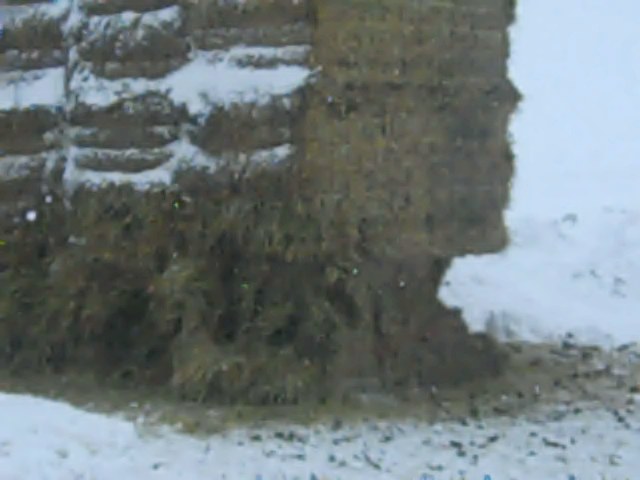
4) Danger to family. OK, now this is something I’ve been working on, and pray that I’ve taught my boys well enough not to have to worry TOO much about it, but I still do. As you can see in this photo, the deer are eating at the hay bales that are easiest to get to…the ones on the ground. Well, you see, each of those bales weigh a little less than a ton. And they are stacked four high. As the deer eat away at the bottom bale, the whole stack becomes unstable…posing a risk for the whole thing to come toppling down.

As the deer eat away at the bottom bales, the whole stack becomes unstable.

Imagine almost 3 tons falling on you? Now, I’m not just concerned about my boys, but what about a Game & Fish officer coming to check on things, or my husband, trying to straighten things out? Or even the deer themselves. (Although, that would seem to be poetic justice to me!)

5) Last, but certainly not least, the deer are costing us money. Not only are we losing feed, and the costs associated with that, but the deer have very good taste. They are eating the hay that we’ve worked very hard to put up in dairy-quality condition. This means that these deer are costing us every where we turn. I can’t give you a real accurate number right now, but we’re talking multiple thousands of dollars. Could you afford to lose $10,000? How about $20,000? Wouldn’t you feel a little frustrated and concerned about it?

Well, we certainly have a lot to discuss and figure out on our way to Mayo…and here I was concerned that we would have nothing to worry about! 😉

Welcome to our herd

A few weeks back, I promised to explain the history of our herd…and I thought today would be a great time to do that!

As I had mentioned a few weeks back, our herd is what would be considered a closed herd. My husband explains it this way: “Well, the only new women on this farm were you and Mom.” Yeah, he has a way with words.

Basically, every cow on this farm is traced back to another cow on this farm…all the way back to the original herd started in the 1950’s. The only new blood (necessary, to prevent in-breeding and defects) on our farm are bulls that are bought periodically. We also use artificial insemination…but I’ll get into that in the future.

Now, this type of ranching may not work for others, but it works for us. We are able to trace back any genetic issues, match up heifers to better bulls for their ease of calving, and have a very detailed history of each calf that is born on our farm.

So, our herd started out as polled Herefords…and now we are Red Angus with Simmental cross. We changed things up when we needed to, made careful choices throughout our history and were able to survive through today. That, in itself, is something to be proud of!


This is an example of a polled Hereford.


It also goes to show that agriculture isn’t just about setting a goal and being strict in your path to get there. Sometimes along the way you need to be willing to veer off the path and try something new, be willing to be flexible and willing to work with whatever is thrown your way.


This is our herd today.


And with four boys coming up, I’m hoping that there will be at least one new woman coming my way!

And the tag means???

I had a question asked of me on Twitter today, or should I say I answered one that was being discussed. Someone was wondering how we decide what tags go on which cows. I had never thought of it before. Sometimes, when you’re on the inside, things seem so obvious that you forget that others don’t know why you’re doing it…it’s an epidemic in agriculture, and one we’re working on fixing.

To answer the question, yes the tag does mean something. When calves are first born (or at least soon after), they get a tag in their ear with the same number their cow has. The white tags mean that the calf is a bull, the yellow tag means that it’s a heifer (a female that hasn’t had a calf yet).

Separating the two sexes of calves helps make giving the calves their vaccinations easier. Plus, you don’t have to worry about trying to castrate a heifer! 🙂

Purple cow

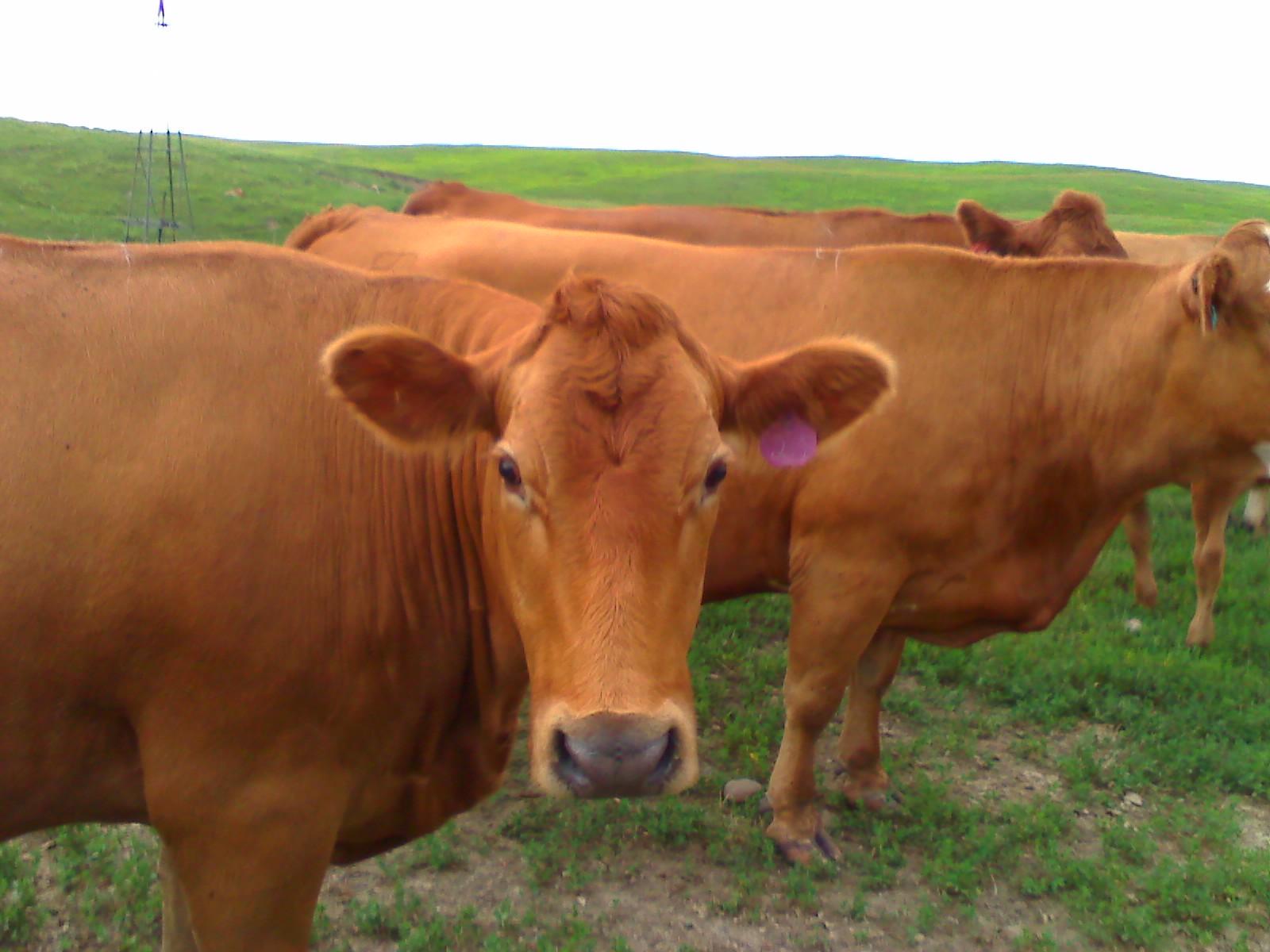
This cow has a purple tag, you can see the one in the background has a blue tag.

Now the cow tags are different colors for a different reason. Each year the cows get a different color ear tag. Tags come in tons of different colors, so it works pretty well. Cows are normally only on the farm for 10-12 years, as long as they have a calf, they stay. You can look at the cows tag and know which year she was born in. (We have a closed herd, which means every cow that’s on our farm was born and raised here…I’ll explain that more in another post some time.)

Another benefit of having different colors is so that you can easily determine which cow you need to bring in (sometimes looking at a sea of red faces is confusing, but the color of the ear tag helps), during calving season…or any other time of the year, if there is a health issue.

There’s a lot more to it then that, but that’ll do for now. I don’t want to overwhelm you with cow information!

If you have any questions, please, feel free to ask. I love talking about our farm…and I’ll gladly take a video or some photos to help out the process! 🙂